Optical clot detection
A light beam through the plasma cuvette is analyzed at 620 nm as fibrin or complexes form.
Semi-Automated Optical Coagulometer
Precision at every clot — routine clinical hemostasis (PT, APTT, TT, fibrinogen, and D-Dimer) with standardized results and minimal manual intervention.
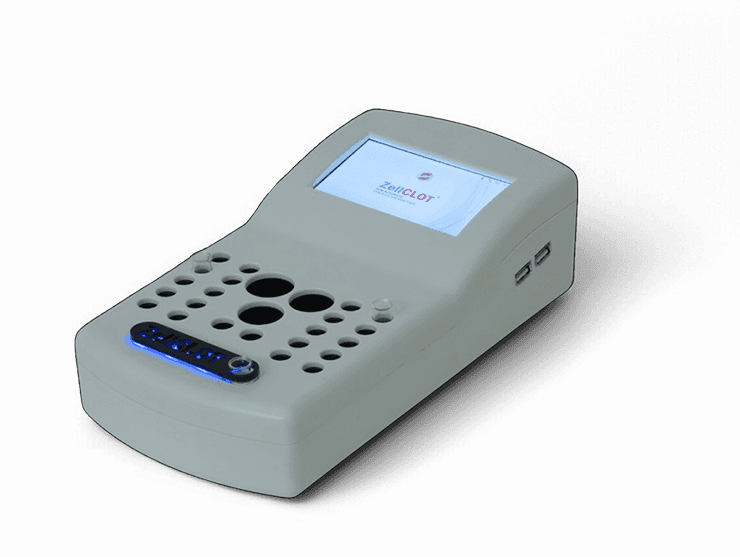
Overview
ZellCLOT® performs routine clinical hemostasis — PT, APTT, TT, fibrinogen, and D-Dimer — with standardized results and minimal manual intervention.
A light beam passes through the cuvette of test plasma to a photodetector. As fibrin or antigen–antibody complexes form, they change the transmitted light, which is converted to a signal and analyzed at 620 nm.
Automatic start, low sample and reagent use, ready-to-use validated reagents, a 4-inch color touchscreen, and LIS connectivity make ZellCLOT® a dependable, virtually maintenance-free coagulometer.
At a glance
Clinical and hospital laboratories performing routine coagulation and hemostasis testing.
Manual clot detection is operator-dependent and slow; laboratories need standardized, low-maintenance hemostasis testing.
A light beam through the plasma cuvette is analyzed at 620 nm as fibrin or complexes form.
Automatic reaction start reduces manual steps and improves consistency.
Efficient consumption with faster throughput for routine hemostasis.
Validated, ready-to-use reagents simplify setup and daily operation.
A simple, robust design keeps upkeep minimal.
Printer, barcode, and LIS interfaces for traceable reporting.
Add 75–150 µL of test plasma to the cuvette; incubation at 37 °C ± 0.2 °C.
A light beam is analyzed at 620 nm; automatic start detects clot formation as transmitted light changes.
PT, APTT, TT, fibrinogen, or D-Dimer results are printed and sent to the LIS.
Applications
Routine prothrombin time testing.
Activated partial thromboplastin time.
Thrombin time testing.
Fibrinogen assay.
D-Dimer testing is included in the assay menu.
ZellCLOT® performs PT, APTT, TT, fibrinogen, and D-Dimer testing.
It is an optical coagulometer: a light beam through the plasma cuvette is analyzed at 620 nm as clotting occurs.
75–150 µL of test plasma, with incubation at 37 °C ± 0.2 °C.
Yes. ZellCLOT® offers printer, barcode, and LIS interfaces for traceable reporting.
Yes. ZellCLOT® uses validated, ready-to-use reagents and features automatic start with low sample and reagent use.
Tell us about your laboratory, throughput, and connectivity needs. Our team will help confirm the right configuration and pricing.